Quantitative finance knowledge areasWhat Quantitative Finance Skills Should You Understand?
Quantitative finance is a broad field. No practitioner knows every pricing model, stochastic process, numerical method, risk framework, market convention, and asset class in equal depth.
A useful assessment should therefore focus on the foundations that influence how quantitative models are built, interpreted, validated, and used.
Algonique can evaluate knowledge across areas such as the following.
Mathematical Foundations for Quantitative Finance
Strong quantitative finance knowledge begins with mathematics.
Useful foundations include calculus, multivariable calculus, linear algebra, optimization, differential equations, series, numerical approximation, and the ability to reason clearly about functions and transformations.
Linear algebra matters for covariance matrices, factor models, principal components, regression, optimization, and numerical methods.
Calculus appears throughout pricing, sensitivity analysis, optimization, stochastic calculus, and continuous-time models.
The goal is not to memorize mathematical machinery for its own sake. It is to understand enough mathematics to know why a financial model behaves the way it does.
Probability and Statistics
Probability and statistics are central to nearly every area of quantitative finance.
Important concepts include random variables, probability distributions, expectation, variance, covariance, correlation, conditional probability, independence, moments, sampling, estimators, confidence intervals, hypothesis tests, likelihood, and regression.
A strong practitioner should also understand the limitations of statistical estimates.
Financial datasets are noisy, samples are often small relative to model complexity, distributions can have heavy tails, and relationships that appeared stable historically may not remain stable.
Statistical significance, economic significance, and out-of-sample usefulness are not the same thing.
Stochastic Processes and Stochastic Calculus
Continuous-time finance relies heavily on stochastic processes.
Useful knowledge includes Brownian motion, geometric Brownian motion, Markov processes, martingales, filtrations, quadratic variation, stochastic differential equations, and Itô's lemma.
These concepts support the mathematical language used in derivatives pricing and continuous-time models.
Understanding them means more than being able to copy an SDE. A practitioner should understand what the drift and diffusion terms represent, how uncertainty accumulates through time, and why stochastic calculus behaves differently from ordinary calculus.
Derivative Pricing and Risk-Neutral Valuation
Derivative pricing is one of the classic areas of quantitative finance.
Important concepts include arbitrage, replication, hedging, state-contingent claims, discounting, equivalent martingale measures, risk-neutral valuation, and the relationship between physical and pricing measures.
A strong understanding should make it clear why derivative prices are not generally obtained by forecasting the expected future payoff under the real-world probability distribution and discounting it at an arbitrary rate.
The pricing argument is connected to replication, no-arbitrage, and the construction of a measure under which appropriately discounted tradable assets behave as martingales.
Black-Scholes Model and the Greeks
The Black-Scholes model remains a fundamental framework for learning derivatives pricing even though real markets violate several of its assumptions.
Useful knowledge includes the Black-Scholes assumptions, geometric Brownian motion, the hedging argument, the Black-Scholes PDE, the closed-form European option price, and the interpretation of the model under a risk-neutral measure.
The Greeks add another layer of understanding.
Delta describes sensitivity to the underlying price, gamma captures the curvature of delta, vega measures sensitivity to volatility, theta reflects time decay, and rho measures sensitivity to interest rates.
A strong practitioner should be able to reason about how these sensitivities interact and why hedging one source of risk can leave exposure to another.
Volatility and Volatility Surfaces
Volatility is one of the most important quantities in derivatives markets.
Useful concepts include historical volatility, realized volatility, implied volatility, volatility smiles and skews, term structure, volatility surfaces, and the difference between a model parameter and a market-implied quantity.
Real option markets do not behave as if one constant volatility applies to every strike and maturity.
Understanding why implied volatility varies across strikes and maturities is an important step beyond the simplest Black-Scholes framework.
More advanced work may involve local volatility, stochastic volatility, jump models, or volatility surface construction and interpolation.
Monte Carlo Simulation
Monte Carlo methods are widely used when a pricing or risk problem cannot be solved conveniently in closed form.
Practitioners should understand random sampling, simulation of stochastic processes, path generation, time discretization, discounting, estimators, convergence, confidence intervals, and numerical error.
For derivative pricing, this also includes understanding why paths are simulated under an appropriate pricing measure and why discounted expected payoffs produce a price estimate.
Variance reduction techniques such as antithetic variates, control variates, importance sampling, or stratification can substantially improve efficiency.
A strong quantitative practitioner should understand not only how to run a simulation, but how to judge whether the result is accurate enough to trust.
Numerical Methods for Pricing
Not every quantitative model produces a convenient analytical formula.
Useful numerical techniques can include binomial and trinomial trees, finite-difference methods, root finding, numerical integration, optimization, interpolation, and numerical solutions of differential equations.
Choosing a numerical method involves trade-offs among speed, stability, convergence, flexibility, and implementation complexity.
For example, early-exercise features can make an American option fundamentally different from a European option and may require a method that explicitly handles the exercise decision.
Fixed Income and Interest Rate Modeling
Fixed income introduces its own set of quantitative concepts.
Important areas include discount factors, zero-coupon rates, spot rates, forward rates, yield curves, bond pricing, duration, modified duration, convexity, bootstrapping, and interest-rate risk.
A practitioner should understand why one yield number is not enough to describe the term structure of interest rates.
More advanced work may include short-rate models, forward-rate models, swaps, swaptions, term-structure calibration, or the modeling of stochastic interest rates.
Portfolio Theory and Asset Pricing
Portfolio construction requires reasoning about return, uncertainty, diversification, and dependence between assets.
Useful topics include expected returns, covariance matrices, correlation, diversification, the Markowitz framework, efficient frontiers, minimum-variance portfolios, Sharpe ratios, the capital market line, CAPM, and factor models.
A strong understanding includes recognizing how estimation error can make theoretically optimal portfolios unstable in practice.
Portfolio optimization is therefore not only a mathematical problem. It is also a problem of noisy inputs, constraints, robustness, turnover, liquidity, and real-world implementation.
Market Risk and Tail Risk
Risk measurement is more than calculating one volatility number.
Useful concepts include volatility, covariance, beta, Value at Risk, Expected Shortfall, drawdowns, stress testing, scenario analysis, sensitivity measures, concentration risk, and tail dependence.
A practitioner should understand what each measure captures and what it ignores.
VaR, for example, describes a quantile of the loss distribution but does not tell you how severe losses can be beyond that threshold. Expected Shortfall addresses a different question by averaging losses in the tail beyond the chosen confidence level.
Credit Risk and Credit Modeling
Credit risk requires modeling the possibility that a counterparty or borrower may fail to meet contractual obligations.
Important concepts include probability of default, loss given default, exposure at default, expected loss, unexpected loss, recovery, credit spreads, rating migration, default correlation, and counterparty risk.
Quantitative credit models can be structural, reduced-form, statistical, or machine-learning based depending on the problem being solved.
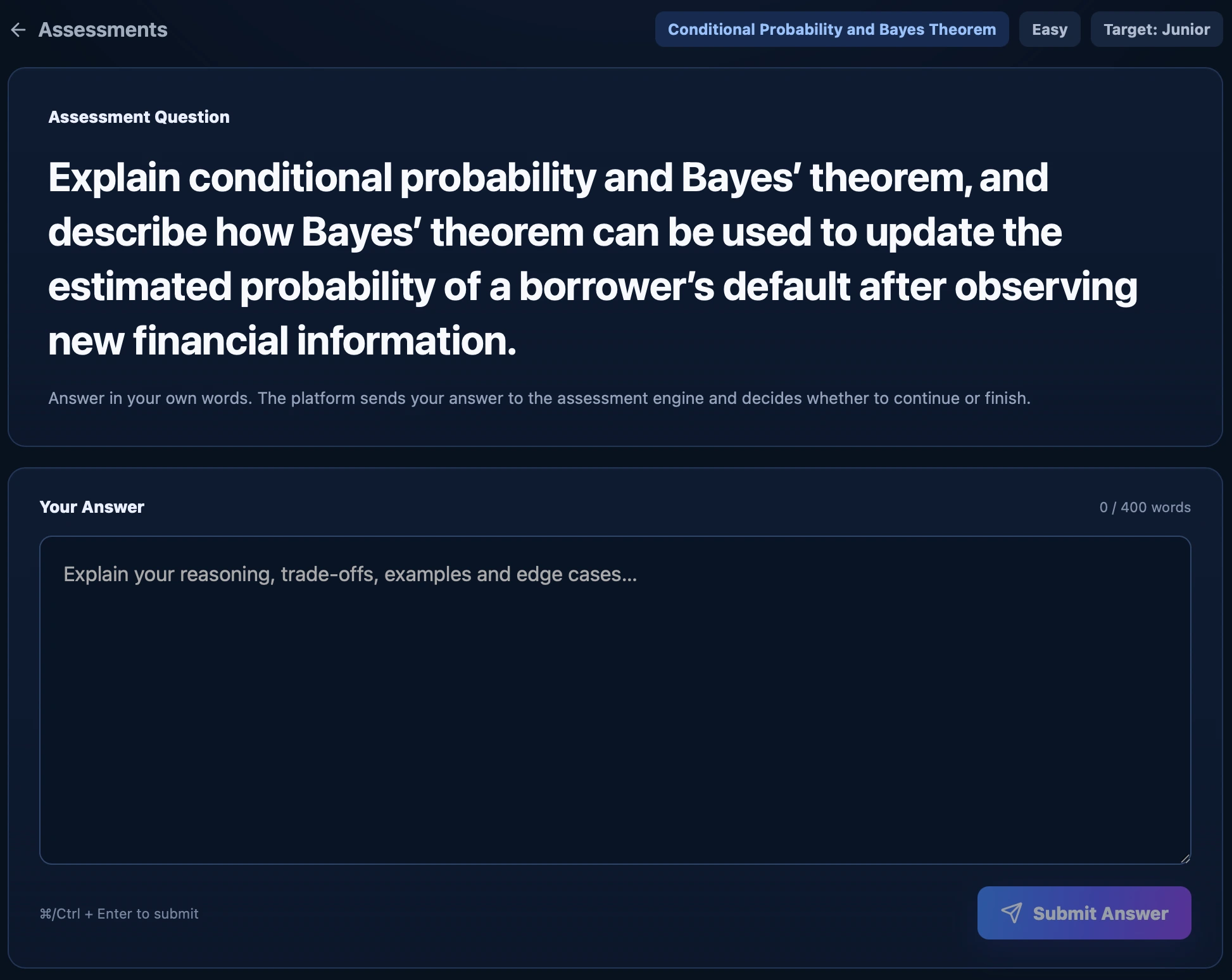
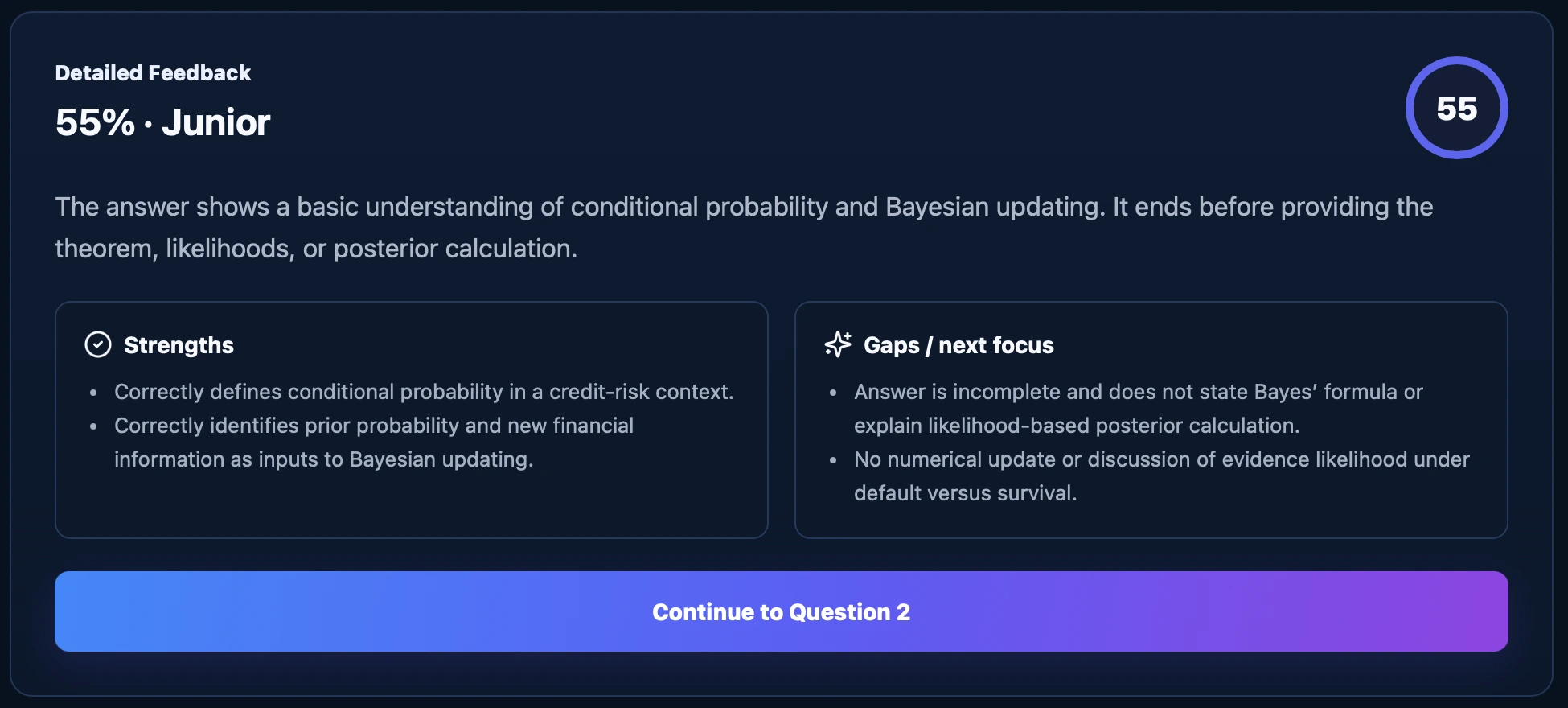
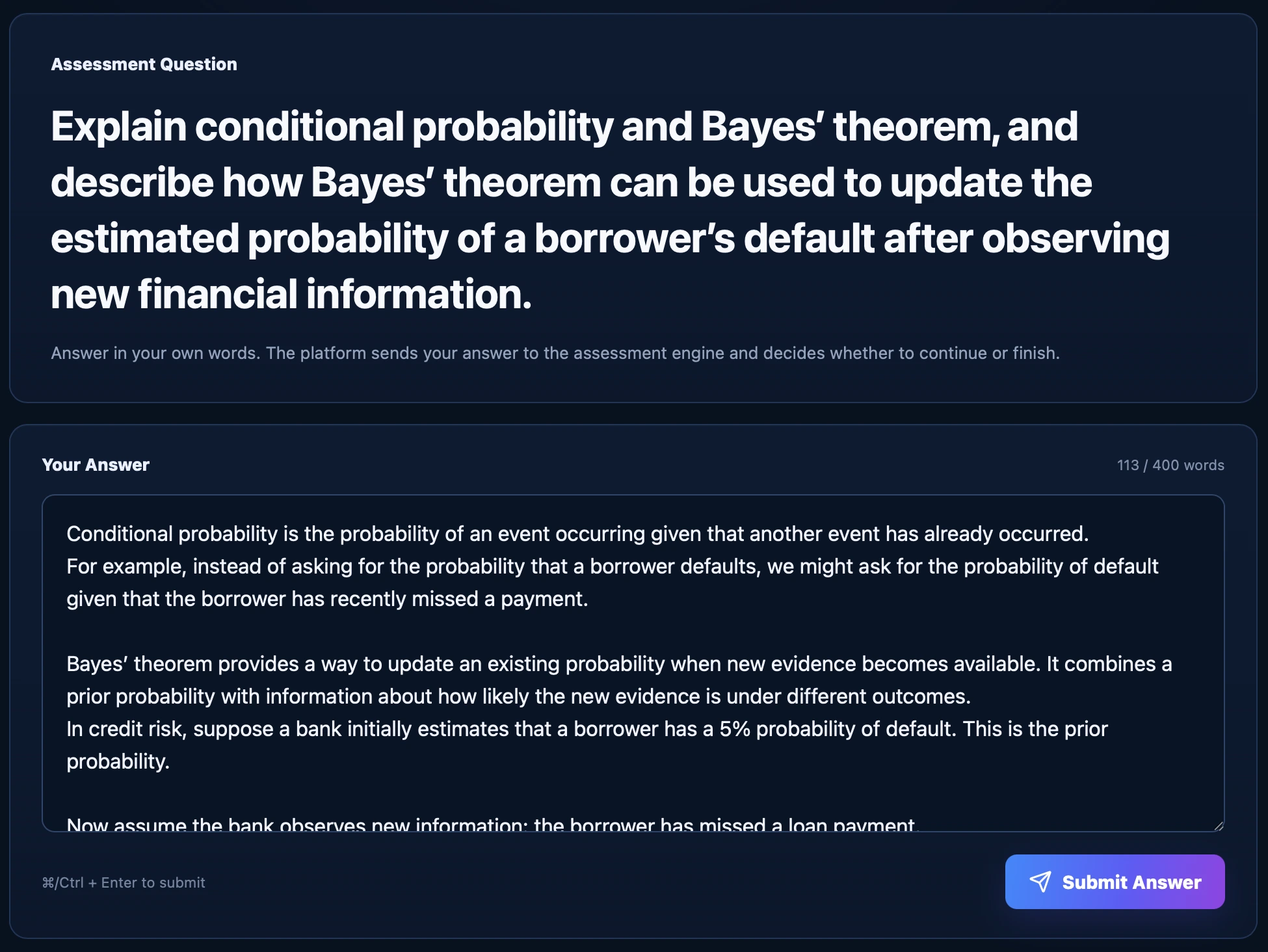
A useful assessment should test whether someone understands the assumptions and economic interpretation of these models, not merely whether they recognize the acronyms.
Financial Time Series and Econometrics
Financial data has properties that make ordinary statistical assumptions unreliable if used without care.
Useful topics include stationarity, autocorrelation, partial autocorrelation, AR and MA models, ARIMA, volatility clustering, ARCH and GARCH models, cointegration, regression, heteroskedasticity, and model diagnostics.
Practitioners should also understand the distinction between historical regularity and a relationship that is likely to persist out of sample.
Regime changes, structural breaks, market microstructure, changing volatility, and non-stationarity can all undermine naive historical inference.
Quantitative Trading and Backtesting
A trading strategy is not credible simply because a historical equity curve looks attractive.
Useful knowledge includes signal construction, position sizing, execution assumptions, transaction costs, slippage, liquidity, turnover, market impact, portfolio accounting, and risk controls.
Backtests must also guard against look-ahead bias, survivorship bias, data snooping, overfitting, unrealistic fills, incorrect corporate actions, and repeated hyperparameter selection against the same history.
A strong quantitative practitioner should ask whether a result could realistically have been achieved with information and execution available at the time.
Machine Learning in Quantitative Finance
Machine learning can be useful in finance, but financial data creates additional challenges.
Important topics include feature engineering, labels, prediction horizons, leakage, cross-validation for time series, class imbalance, regularization, tree-based models, neural networks, clustering, regime classification, model interpretation, and production monitoring.
Standard random train-test splits can be inappropriate when the temporal structure of the data allows future information to leak into the past.
The central question should not be whether a model is sophisticated. It should be whether the experimental design is valid and whether the model creates useful out-of-sample information after costs and constraints.
Model Validation and Model Risk
A quantitative model should not be trusted simply because it produces plausible numbers.
Validation may involve benchmarking against known solutions, independent implementations, sensitivity analysis, limiting cases, calibration checks, out-of-sample testing, stress testing, numerical convergence tests, and comparison with market observables.
Model risk also includes the possibility that the model is mathematically correct but inappropriate for the situation in which it is being used.
Strong quantitative practice therefore requires understanding both the model and the limits of the model.
Strong quantitative finance knowledge is not about memorizing every formula. It is about understanding the assumptions, mathematics, financial logic, and limitations well enough to reason with the models.