Blockchain knowledge areasWhat Blockchain and Cryptocurrency Skills Should You Understand?
Blockchain is a broad technical domain. No developer, researcher, investor, or practitioner understands every protocol, chain, token, cryptographic primitive, and application in equal depth.
A useful blockchain knowledge assessment should therefore focus on foundations that influence how decentralized systems work and how people reason about them.
Blockchain Fundamentals
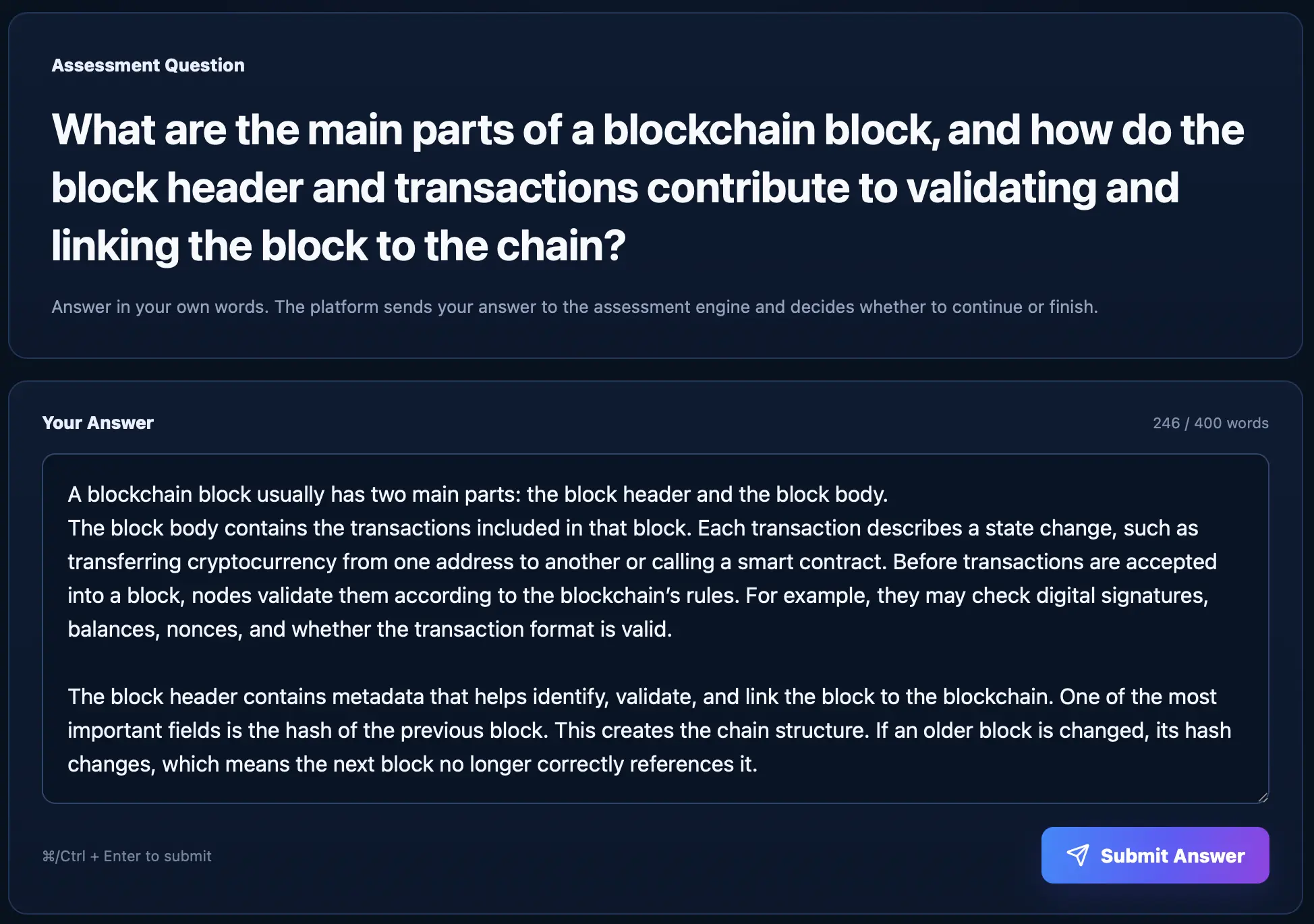
Strong blockchain knowledge begins with understanding transactions, blocks, hashes, nodes, replication, validation, consensus, and the difference between centralized and decentralized systems.
A practitioner should understand why multiple independent nodes can maintain a shared state without relying on a single database administrator and why different blockchain designs make different trade-offs around trust and decentralization.
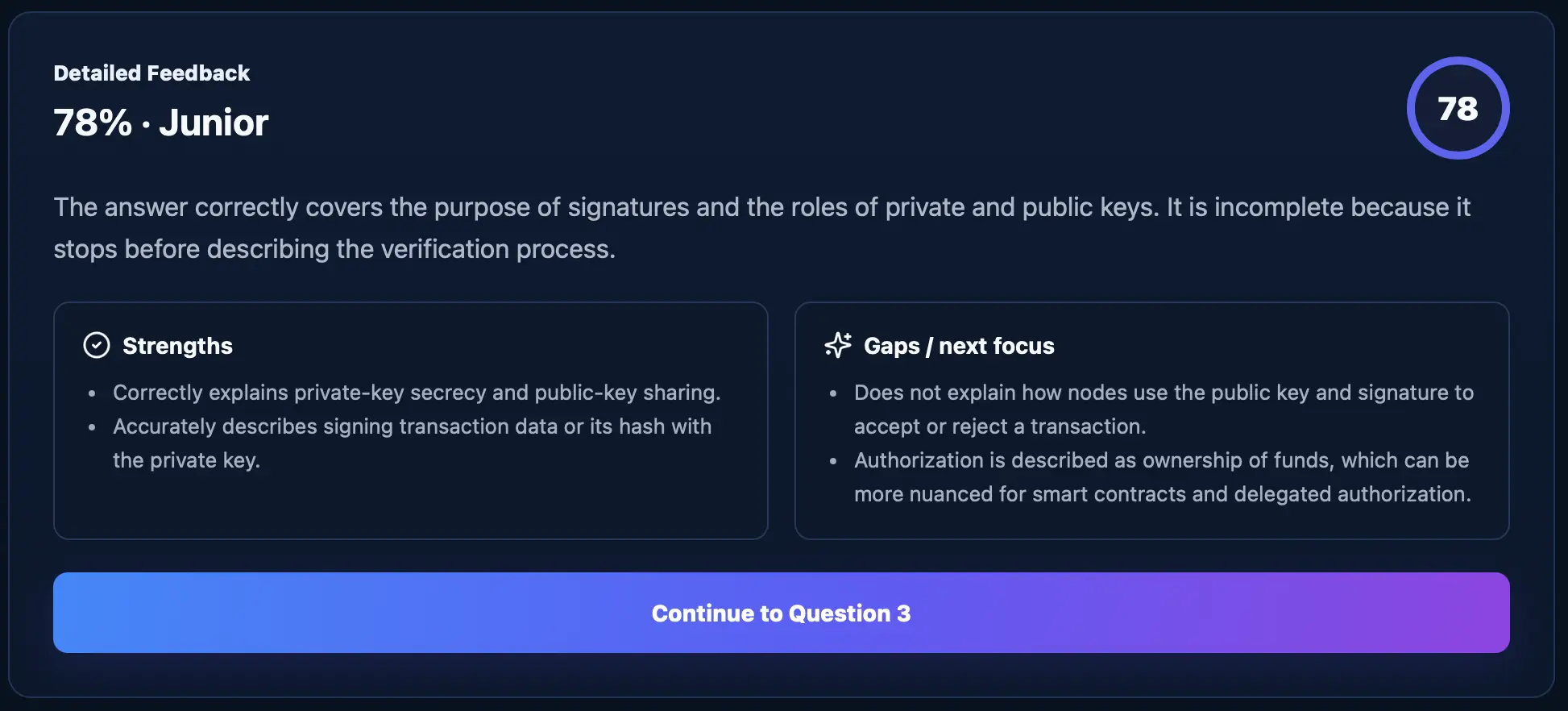
Cryptography and Digital Signatures
Important concepts include cryptographic hash functions, public and private keys, digital signatures, addresses, integrity, authentication, and computational security.
A strong understanding includes knowing what hashing does and does not provide, why a private key must remain secret, how a signature proves authorization, and why signing is different from encrypting data.
Bitcoin and the UTXO Model
Useful knowledge includes proof of work, mining, blocks, transaction fees, confirmations, the UTXO model, inputs and outputs, change outputs, transaction validation, mempools, and the role of full nodes.
Understanding Bitcoin also means understanding that a wallet does not literally store coins. It manages keys that authorize spending of outputs represented on the blockchain.
Consensus Mechanisms
Distributed systems need a way to agree on which state is valid. Blockchain practitioners should understand the purpose of consensus and common approaches such as proof of work and proof of stake.
Important questions include who participates, what resources or economic stakes are involved, how conflicting histories are resolved, what finality means, and what kinds of attacks or failures a protocol attempts to tolerate.
Ethereum and Smart Contract Platforms
Ethereum extends blockchain from asset transfer to programmable state transitions. Useful concepts include accounts, transactions, gas, state, the EVM, contract deployment, storage, events, calls, and execution.
Developers should understand that blockchain execution has constraints that do not exist in a traditional backend. State changes are public, computation has a direct cost, and deployed code may control assets that cannot be recovered easily after a bug.
Smart Contracts and Solidity
Important areas include Solidity types, functions, modifiers, visibility, mappings, arrays, events, inheritance, interfaces, storage, memory, calldata, external calls, payable functions, and error handling.
But syntax is only part of the picture. Developers also need to reason about state transitions, access control, trust boundaries, gas, contract interactions, and upgradeability.
Smart Contract Security
Smart contracts can directly control valuable assets, which makes security central to blockchain engineering.
Useful knowledge includes reentrancy, access-control failures, unsafe external calls, oracle manipulation, frontrunning, transaction-order dependence, authorization errors, upgrade risks, and assumptions about external protocols.
Security knowledge is not about memorizing exploit names. It is about learning to reason about how authority, state, and value move through a system.
Wallets, Keys, and Custody
Cryptocurrency ownership depends heavily on key management. Practitioners should understand private keys, seed phrases, addresses, signing, hot and cold wallets, hardware wallets, custodial and non-custodial models, multisignature arrangements, and recovery risks.
Many real-world losses are not caused by a failure of the underlying blockchain but by compromised keys, phishing, malicious approvals, insecure applications, or custody mistakes.
Tokens and Token Standards
Blockchain applications often use tokens to represent assets, rights, governance, or application-specific value.
Useful concepts include fungible and non-fungible tokens, balances, transfers, approvals, allowances, minting, burning, ownership, and common token standards. Token design can also introduce economic and governance considerations that go beyond programming.
Decentralized Finance
DeFi combines smart contracts with financial mechanisms. Relevant concepts can include decentralized exchanges, automated market makers, liquidity pools, lending, borrowing, collateral, liquidation, stablecoins, oracles, staking, yield, and composability.
Understanding DeFi requires more than knowing how to connect a wallet. Users and developers need to reason about smart contract risk, liquidity, oracle dependencies, collateralization, leverage, impermanent loss, and protocol dependencies.
Scaling, Layer 2, and Interoperability
Public blockchains face practical limits around throughput, latency, and cost. Scaling approaches may include rollups, channels, sidechains, alternative execution environments, and other architectural techniques.
Useful knowledge includes the distinction between execution, settlement, consensus, and data availability, as well as the trust assumptions introduced by bridges and cross-chain systems.
Token Economics and Incentives
Blockchains are technical systems with economic participants. Incentives influence miners, validators, liquidity providers, token holders, governance participants, users, and developers.
Useful knowledge can include issuance, supply schedules, transaction fees, staking rewards, inflation, token utility, governance, and the relationship between economic incentives and protocol security.
Strong blockchain knowledge is not about memorizing every protocol. It is about understanding the mechanisms well enough to reason about trust, state, incentives, security, and decentralized execution.