AI knowledge areasWhat AI Skills Should You Actually Understand?
Artificial intelligence is a broad field, and no practitioner knows every algorithm, architecture, framework, paper, or implementation detail.
A useful AI knowledge assessment should therefore focus on foundations and reasoning skills that influence how people build, evaluate, debug, and deploy intelligent systems.
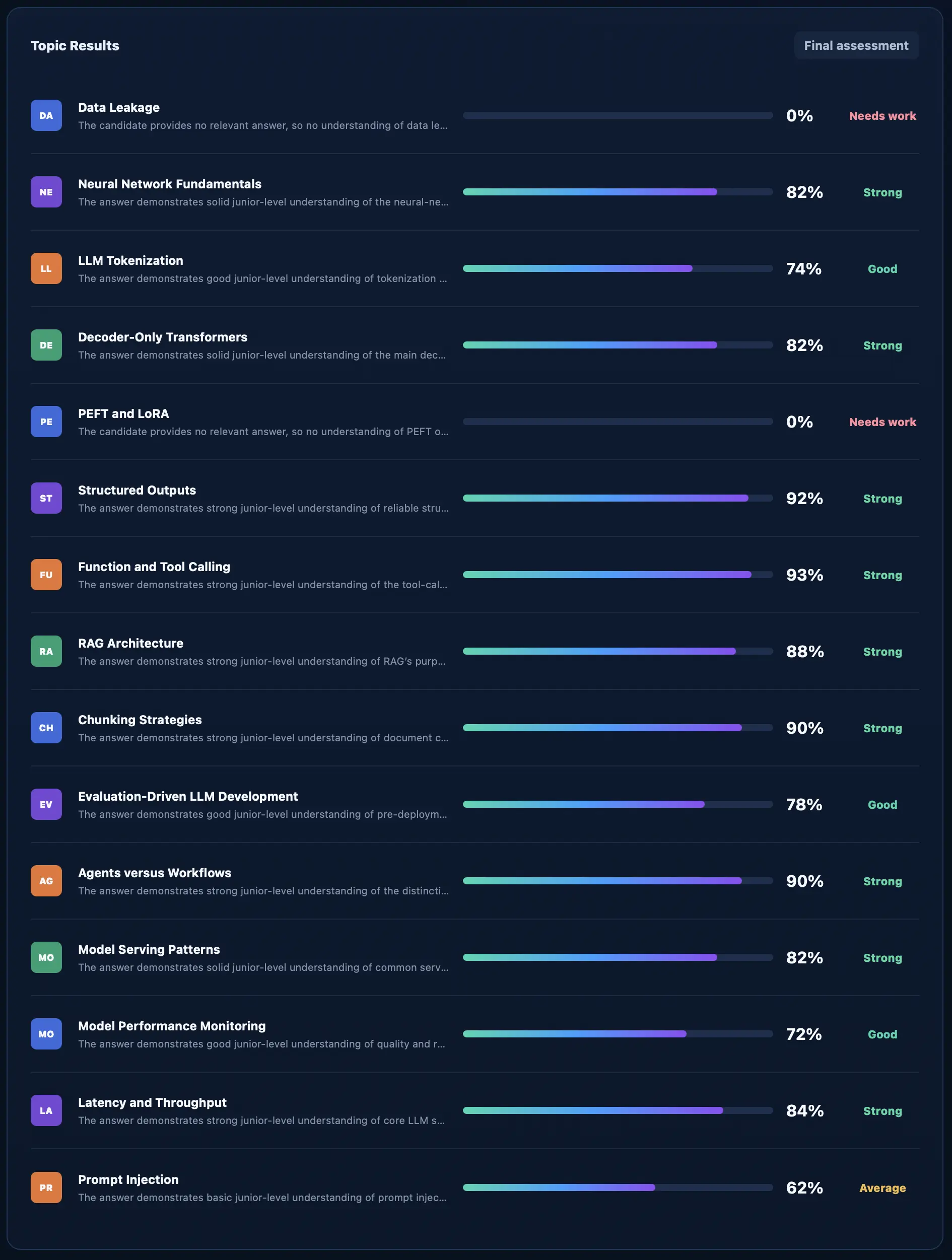
Algonique can evaluate knowledge across areas such as the following.
AI Foundations and Problem Framing
Strong AI work begins before a model is trained.
A practitioner should understand what kind of problem is being solved, what the target represents, what information is available at prediction time, and how a model's output will actually be used.
This includes understanding the distinction between supervised and unsupervised learning, classification and regression, prediction and decision-making, training and inference, and offline metrics versus real-world outcomes.
Poor problem framing can produce an impressive model that solves the wrong problem.
Probability, Statistics, and Data
Machine learning depends heavily on statistical reasoning.
Useful knowledge includes probability distributions, expectation, variance, sampling, correlation, conditional probability, uncertainty, hypothesis testing, confidence intervals, and the relationship between a sample and the population it represents.
Just as important is understanding data quality.
Missing values, noisy labels, class imbalance, sampling bias, leakage, non-stationarity, and distribution shift can matter more than the choice between two sophisticated models.
Supervised Machine Learning
Supervised learning remains one of the foundations of applied AI.
Practitioners should understand common approaches such as linear models, logistic regression, decision trees, random forests, boosting methods, support vector machines, nearest neighbors, and neural networks at an appropriate level for their role.
The goal is not to memorize every algorithm.
More important is understanding assumptions, strengths, weaknesses, model complexity, regularization, interpretability, computational trade-offs, and the situations in which one family of models may be more appropriate than another.
Model Evaluation and Validation
A model is not useful simply because it performs well on the data used to create it.
AI practitioners should understand training, validation, and test sets; cross-validation; baseline models; overfitting; underfitting; hyperparameter tuning; and the dangers of repeatedly optimizing against the same holdout set.
Metric selection also matters.
Accuracy can be misleading for imbalanced classification. Precision and recall capture different kinds of mistakes. ROC-AUC and PR-AUC summarize different aspects of ranking performance. Regression problems may require MAE, MSE, RMSE, or domain-specific metrics.
A strong practitioner should be able to connect the metric with the actual cost of errors.
Feature Engineering, Leakage, and Experimental Design
Many machine learning failures are caused by the experiment, not the algorithm.
Feature engineering requires understanding which information is available, how variables should be represented, whether a transformation leaks future information, and how preprocessing must be fitted without contaminating validation data.
Time-series and financial data introduce additional risks such as look-ahead bias, temporal leakage, non-stationarity, and unrealistic splitting strategies.
Being able to recognize these problems is often more valuable than knowing another modeling library.
Deep Learning
Deep learning introduces a different set of concepts and trade-offs.
Useful knowledge includes neural network layers, activation functions, forward propagation, loss functions, gradient descent, backpropagation, initialization, normalization, regularization, optimization, batching, and learning-rate behavior.
Depending on the application, practitioners may also need to understand convolutional networks, sequence models, embeddings, attention, and transfer learning.
The important question is not only how to train a network, but why training succeeds or fails and how to diagnose the result.
Transformers and Large Language Models
Modern AI work increasingly involves transformer-based models and large language models.
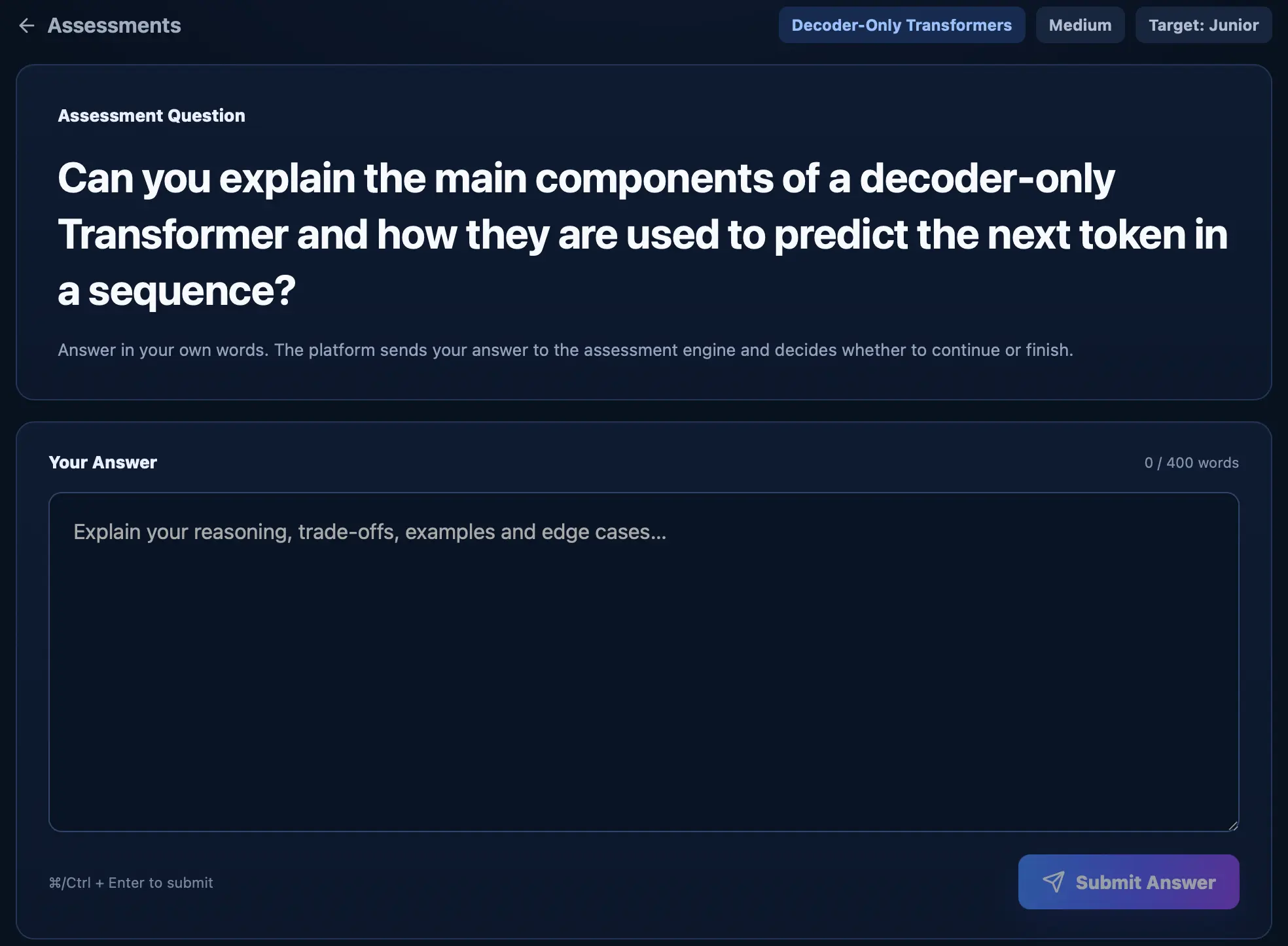
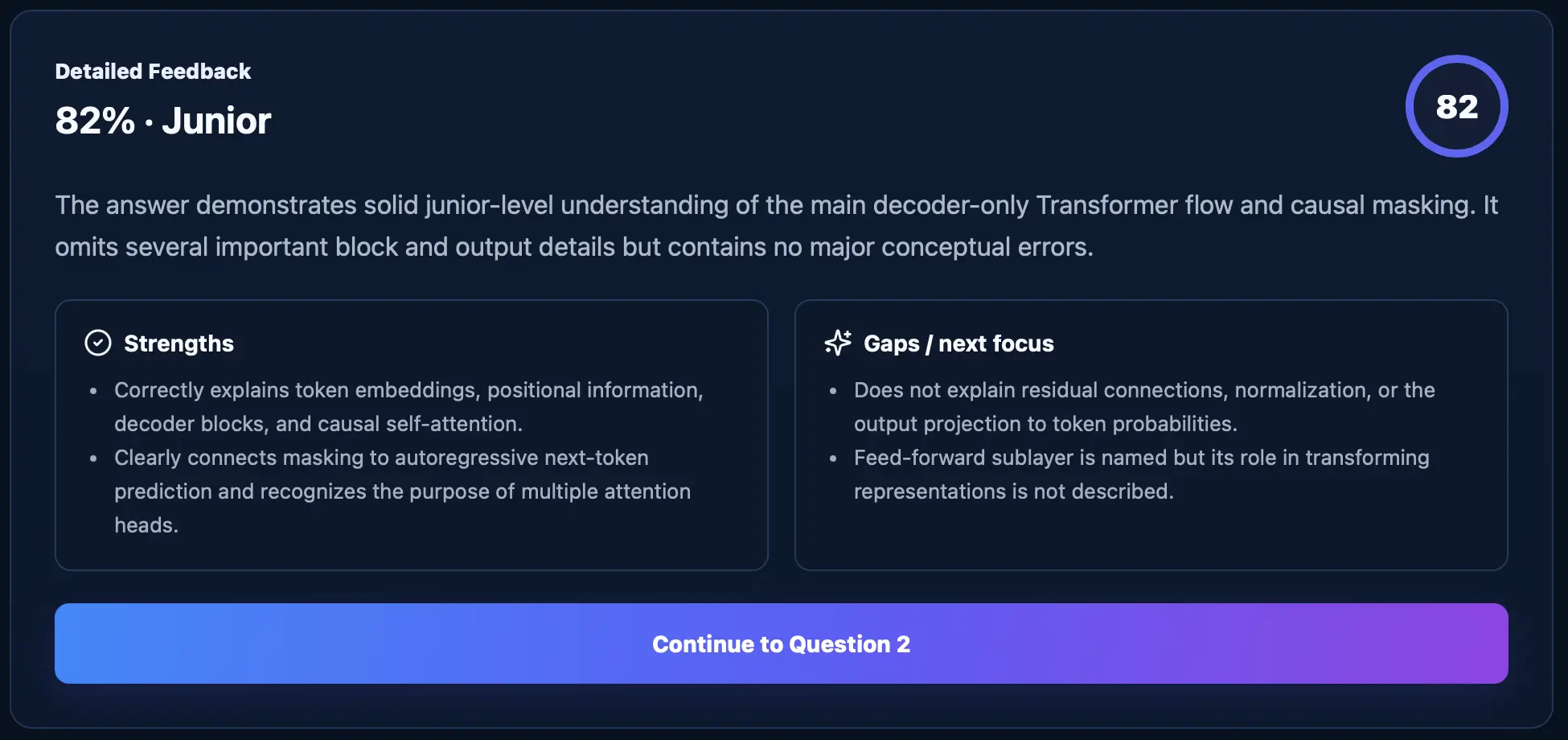
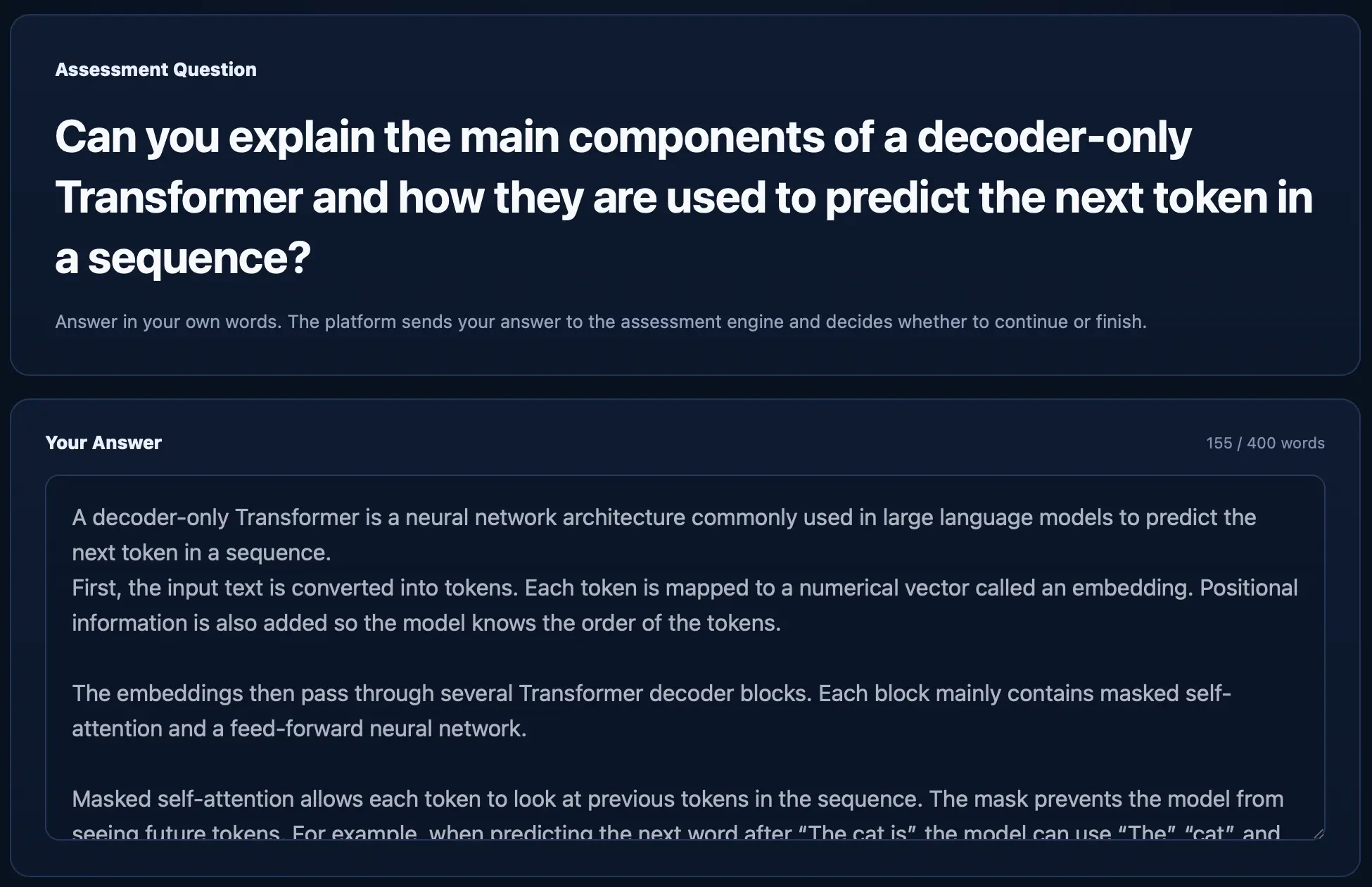
Useful concepts include tokenization, embeddings, self-attention, positional information, context windows, autoregressive generation, pretraining, instruction tuning, fine-tuning, inference parameters, and the limitations of probabilistic text generation.
Building an LLM application also requires understanding that a fluent answer is not automatically a correct answer.
Hallucination, grounding, evaluation, prompt sensitivity, latency, token usage, privacy, and cost all become engineering concerns.
Retrieval-Augmented Generation and AI Agents
Generative AI systems often combine models with external knowledge and tools.
Retrieval-augmented generation introduces concepts such as chunking, embeddings, vector search, retrieval quality, reranking, context construction, grounding, and evaluation of both retrieval and generation.
Agentic systems add tool use, planning, workflow state, retries, permissions, failure recovery, and the question of when autonomous behavior is actually appropriate.
Knowing how to call a framework is useful, but understanding these underlying trade-offs is what makes an AI system more reliable.
Production AI and MLOps
A model that works in a notebook is not automatically ready for production.
Production AI involves serving patterns, batch versus online inference, latency, throughput, resource use, model versioning, reproducibility, monitoring, drift, data quality, rollback, and safe deployment.
Teams also need to distinguish data drift from concept drift and from ordinary model-performance deterioration.
Monitoring should connect technical model behavior with the outcomes the system is supposed to support.
Responsible AI, Limitations, and Risk
Technical performance is only part of AI quality.
Practitioners should understand that training data can contain bias, evaluation data can fail to represent real users, and automated decisions can have different consequences across groups and contexts.
Responsible AI work can involve fairness, transparency, privacy, security, human oversight, explainability, misuse, robustness, and appropriate limits on automation.
The depth required depends on the role, but recognizing the limitations of AI systems is an important part of understanding them.
Strong AI knowledge is not about memorizing every model. It is about understanding the concepts well enough to reason about data, experiments, models, and real systems.